Military obedience to orders
Across the River and into the TreesMilitary obedience to orders is the rule the Colonel describes as indispensable to army life and morally dangerous in practice: a soldier is expected to carry out commands even when he believes they are wrong, while the human cost falls on those who must execute them. The novel sets that principle against the Colonel’s experience as both a fighting officer and a commander whose regiment is destroyed under orders, exposing the distance between military authority and battlefield consequence.
The Rule and Its Language
The Colonel gives the rule its starkest formulation while explaining why he obeyed commands he believed mistaken: “In our army you obey like a dog,” he says, adding that a soldier can only hope for a good master. The image makes obedience less a matter of agreement than of submission to authority. The narrative later distills the same principle into the sentence “All a man need ever do is obey.” Its flat, almost casual phrasing contrasts with the losses the rule has already produced, so that the maxim reads less as reassurance than as an indictment of a system that can make compliance sound like the end of moral deliberation.
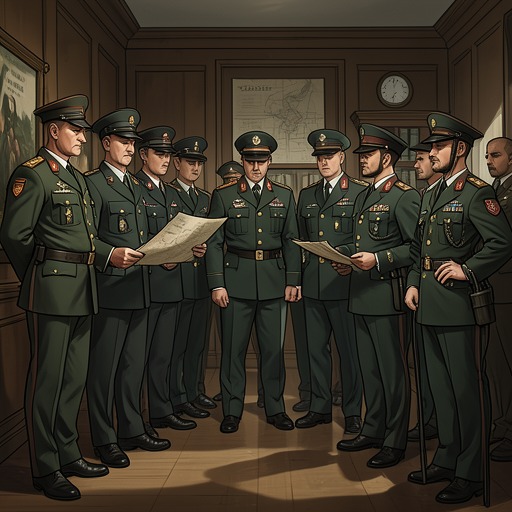
The army’s command structure gives that submission a concrete shape. In the Colonel’s account, an order to take a town by assault may arrive by telephone from Corps, carrying instructions from Army, Army Group, or even the Supreme Headquarters Allied Expeditionary Force. He speculates that a town’s name may have appeared in a newspaper and that this publicity may have helped make its capture seem important. The uncertainty about who initiated the demand does not soften its force: once the order arrives, the assault must proceed.
The Assault and Its Cost
The Colonel contrasts the command’s demand with what he believes could have happened on the ground. His men are working toward high ground, and he thinks the opposing professionals might have discussed terms and come out if a flag were sent. Instead, the order is to take the town by assault. He describes the resulting losses in specific units: one company is left dead along a draw, another is lost completely, and three more are destroyed. Tanks are hit as they move. The account makes obedience consequential not in the abstract, but in the destruction of formations and the loss of men under a decision the commander considers avoidable.
The wider operation compounds the danger. The Colonel recalls an attack planned with three forces in line and nothing in reserve, against ground he describes as like “Passchendaele with tree bursts.” The United States Army Twenty-Eighth Division is already bogged down nearby, providing warning about the conditions. Even so, a regiment is ordered into the operation before the attack begins. That commitment makes the removal of divisional patches, intended to conceal the attackers’ identity, futile: the enemy would have a prisoner who could identify them. The Colonel’s account presents the mismatch between operational secrecy and the command decision as another instance of orders overriding local assessment.
Afterward, he looks back on the regiment as something he had inherited rather than built, but had briefly regarded as his greatest joy. Every second man is dead, and nearly all the rest are wounded; he says the regiment was beautiful until he destroyed it under other people’s orders. The scale of the loss gives his question about why a commander must obey when he knows better its full weight. He does not claim that obedience absolves him: he names himself as the person who destroyed the regiment, even as he identifies the orders that constrained his choice.
Command, Judgment, and Responsibility
The Colonel’s account does not reduce the chain of command to a single villain. In recalling the operation, he says Walter Bedell Smith made promises and explained how it would go, but expressly refuses to call him the villain. That refusal complicates the assignment of blame: responsibility is distributed through a hierarchy, while the immediate commander still experiences himself as answerable for what happens to his men. The gap between the authority that issues an order and the officer who must carry it out is central to the rule’s moral cost.
The battlefield narrative also distinguishes obedience from effective judgment. Earlier, as a lieutenant during a winter of attacks, the Colonel remembers enemy shelling being lifted and moved ahead of an attack in stages. He believed that, had the defenders been forced back to the Sile, the attackers might have concentrated their guns more closely and continued until they breached the line; instead, he thought, a distant “high fool” controlled the bombardment piecemeal. In that earlier experience, the enemy’s command decisions appear to give his own men a chance to withstand the attacks. The contrast with the later assault shows that the Colonel’s criticism is not simply of command itself, but of decisions made without adequate regard for the conditions and consequences faced by the troops.
Soldiers, Evasion, and the Order
The Colonel and the Gran Maestro also remember soldiers who tried to avoid being sent into another attack. They know of poor men who shared the contents of a matchbox to produce illness, and of wealthier men who arranged other ways to evade military service. The Colonel observes that American troops might have performed as well as, or better than, the Italians in earlier battles, but says that in his own army men did not shoot themselves to obtain wounds. His distinction places formal discipline beside informal resistance: some soldiers obeyed, while others sought ways to escape what obedience required of them.
Their shared knowledge of these evasions, and of the people who profited from war, helps explain why the Colonel and the Gran Maestro founded the Order. Their bond rests partly on an understanding of the fear and desperation of boys sent toward lethal attacks, rather than on a belief that every soldier’s conduct can be judged apart from the system directing him. The rule of obedience thus has two linked consequences in the novel: it channels men into combat, and it shapes the private strategies by which some try to survive that demand.
The Rule’s Moral Limit
The Colonel’s memories of fighting prevent obedience from becoming a simple measure of virtue. During the winter attacks, he killed enemy soldiers but says he never hated them; he taught his own men to shoot and to look at the enemy as they fired. Later, when Renata speaks of those who killed her father and burned her family’s villa, he asks her to understand his attitude toward former enemies: after killing so many, he says, people can afford to be kind. His words do not erase the killing; they show how experience has altered his relation to those on the other side.
Across these episodes, obedience remains a rule of military organization, but not a complete moral defense. The Colonel accepts that he obeyed, recounts what obedience cost his regiment, and continues to identify the decisions he thought wrong. The tension between duty and judgment is left unresolved: command can require action, but the order itself cannot make its consequences disappear.